Project Management
The good feeling that everything is going well
What do the best plans and concepts use if there is a lack of implementation? For us, the core of a trusting cooperation is project management that consistently holds the strings in our hands. Our goal is that time, cost and quality requirements are met. Unsolving deviations must be communicated and addressed transparently, pragmatically and solution-oriented.
Our project managers work goal-oriented and proactively. You have a permanent contact person who represents your interests vis-à-vis all project participants.
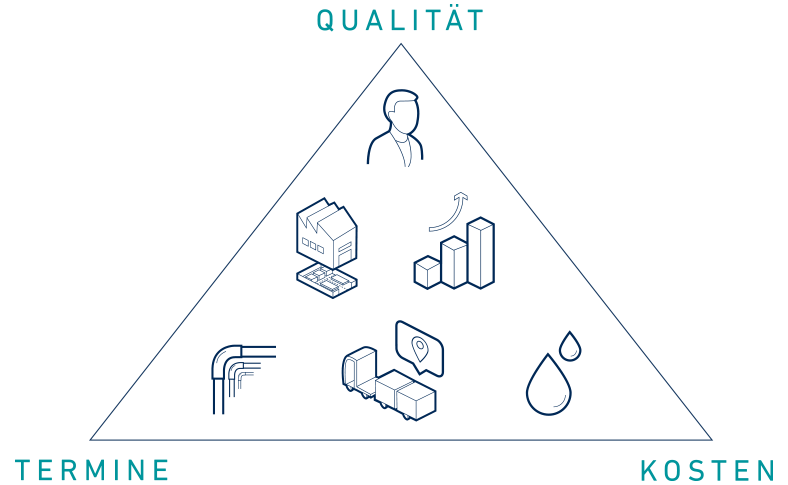


Meeting quality, budget, and schedule objectives are key tasks in project management that often stand in tension with one another. For example, adhering to a tight project deadline may require shortened tendering phases, which can in turn lead to higher production costs. In practice, however, expectations continue to rise for projects to be completed faster, more cost-effectively, and at the highest possible quality standards. It is therefore all the more important to define ambitious yet realistic goals that the project team can identify with and fully commit to.
When budgets and schedules are planned too tightly, this often results in overlapping project phases that depend on one another—ultimately leading to higher costs, schedule delays, and, above all, demotivation within the project team.
A professional project management approach therefore relies on:
-
ambitious yet realistic schedule and cost targets
-
transparent communication within the project team
- clear structures and responsibilities
A structured project initiation is crucial for the project’s later success. At the outset, project objectives should be clearly defined, taking into account the company’s overarching strategic goals. For example, a corporate objective might be to increase sales at a specific site. Derived from this, a corresponding project goal could be the design and implementation of a material flow– and space-optimized machine layout aimed at achieving maximum production performance.
Based on the defined project objectives, the planning steps and corresponding responsibilities are outlined. The result is a project organization chart that answers the question: Who does what? This is followed by the definition of communication channels through which project progress is documented and monitored. These include the establishment of working groups, regular meetings, escalation paths, and standardized procedures – for instance, in reporting (e.g. meeting minutes and documentation structure).
Before the project officially starts, the main planning steps should be recorded in a schedule that includes the key milestones agreed upon by the project team. This schedule will be further detailed as the project progresses. It is essential to keep the critical path in focus – that is, the sequence of activities that are directly interdependent and could jeopardize the overall project completion date.
Establishing a budget plan early on also helps to keep costs under continuous control. The DIN 276 standard provides a proven structure for presenting and systematically tracking costs throughout the project lifecycle.
The Fee Structure for Architects and Engineers (HOAI) is a widely used approach for remunerating design and planning services in construction projects. It defines distinct service phases, describes the corresponding tasks, and calculates the fee as a proportion of the eligible construction costs. This method is transparent; however, it also creates a potential conflict of interest, as the planners’ fees increase in line with rising construction costs for the client. To counteract this, a combination of the HOAI’s structured service phases with billing on a time and materials (effort and verification) basis can represent a sensible alternative.
In practical terms: “Creating cost savings in the client’s interest – and being rewarded for it.”