Factory planning
Your factory of the future
Investments in your plant are made for a long time. Therefore, the entire planning and implementation of your project must be carried out with precision and responsibility. We work with foresight and state-of-the-art technology. It goes without saying that we take into account the important aspects of skilled workers, energy, climate, globalization and digitalization.
Your advantage: Your new factory will be fit for the future thanks to high efficiency, short distances, optimized use of resources and smooth processes. And: Your employees will be motivated and happy to work in your factory. All this is our job.
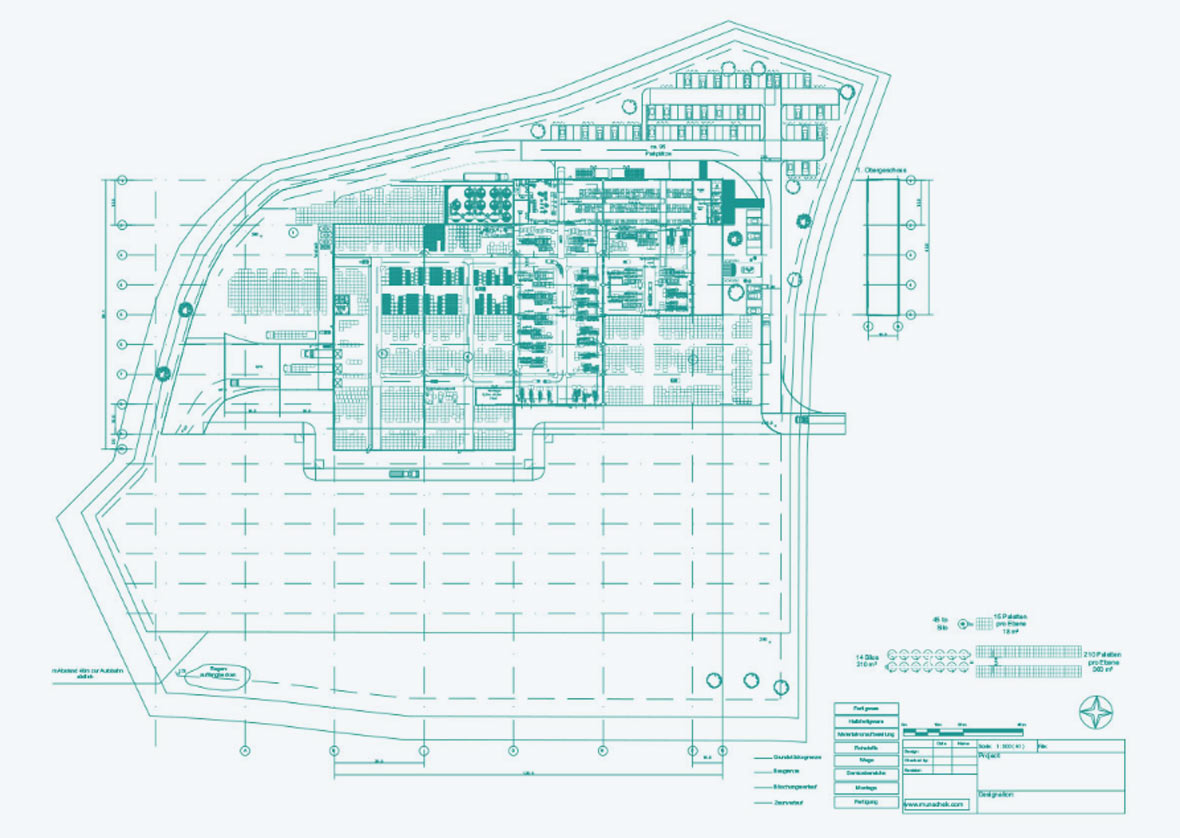
Our performance
Your benefit
- An experienced design specialist at your side
- A supplier-independent project partner representing your interests
- Close, practice-oriented cooperation with your project team
- Planning and investment security through well-founded engineering
- Optimal surface utilisation
- Process optimization and conservation of resources
- Adaptable and versatile factory structure (future-proof)
- Realization during operation
- Integrated technical planning from a single source
or directly by email: factoryplanningnoSpam@munscheknoSpam.com
Factory planning lays the foundation for successful production by guiding the process through several structured phases, from the initial idea to final commissioning. Especially in the early project stages, when objectives and boundary conditions are not yet clearly defined, systematic planning provides a sound basis for decision-making. According to VDI 5200 Part 1, it is a “systematic, goal-oriented process” that covers all relevant phases up to the start of production.
Following the principle of “form follows function”, factory planning develops the optimal production environment in a series of steps:
Requirement Analysis: Assessment of requirements, boundary conditions, and initial concept ideas.
Strategy and Concept Phase: Development of alternatives and solution approaches based on material flows and production processes.
Preliminary and Detailed Layout: Creation of different layout options, including opportunities for optimization.
Implementation Planning: Detailed planning for execution, including schedules, investment costs, and economic feasibility.
Execution and Ramp-Up: Support during commissioning and production launch.
A structured step-by-step plan ensures a clear roadmap for implementation—covering investments, operating costs, and impacts on manufacturing costs. Through professional factory planning, companies can create efficient, flexible, and future-proof factories that can be operated profitably.
Without professionalism in factory planning, inefficient structures often emerge, making future adjustments difficult and leading to unnecessary costs:
- Planning gaps: Key factors such as material flows, ergonomics, or scalability are often overlooked.
- More iteration cycles required: Planning errors result in frequent adjustments, delays, and significant follow-up costs.
- Lack of integration: Production, logistics, and support functions are not properly aligned, causing bottlenecks.
- Outdated, short-sighted structures: Unplanned growth leads to inefficient processes that complicate future expansions.
- Lack of holistic perspective: Individual areas may function in isolation, but overall factory efficiency suffers.
- Poor space utilization: Production and storage areas are not used effectively, leading to long-term space shortages or inefficient workflows.
- Insufficient flexibility: Adapting to new technologies or changing production requirements becomes difficult.
- Higher operating costs: Missing energy and resource optimization results in unnecessarily high running costs.
Building without professional factory planning risks inefficient processes, elevated operating costs, and expensive rework. By contrast, early, well-structured planning ensures a scalable, cost-efficient, and future-proof factory.
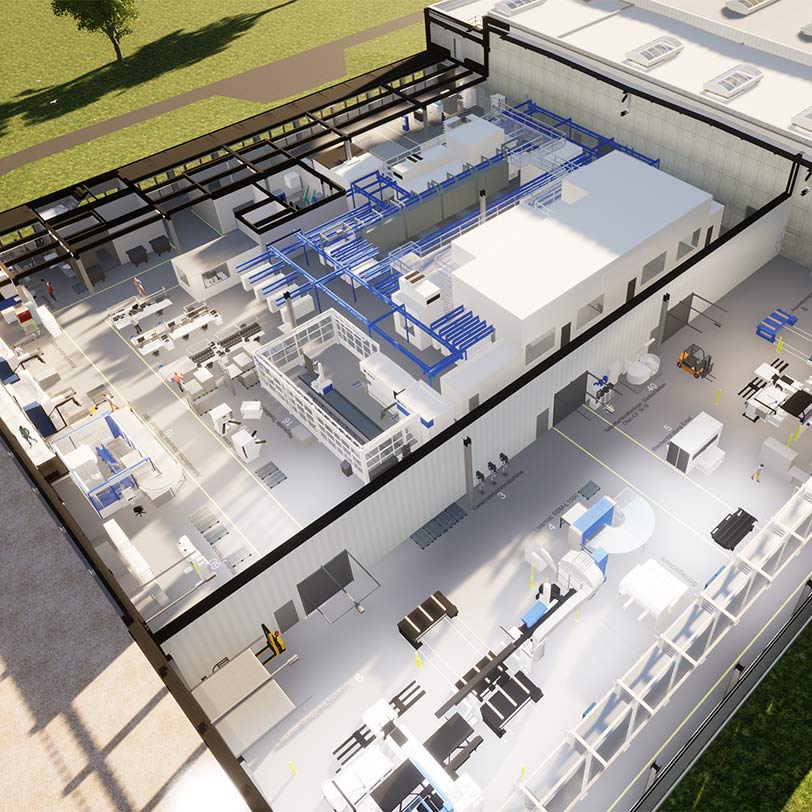
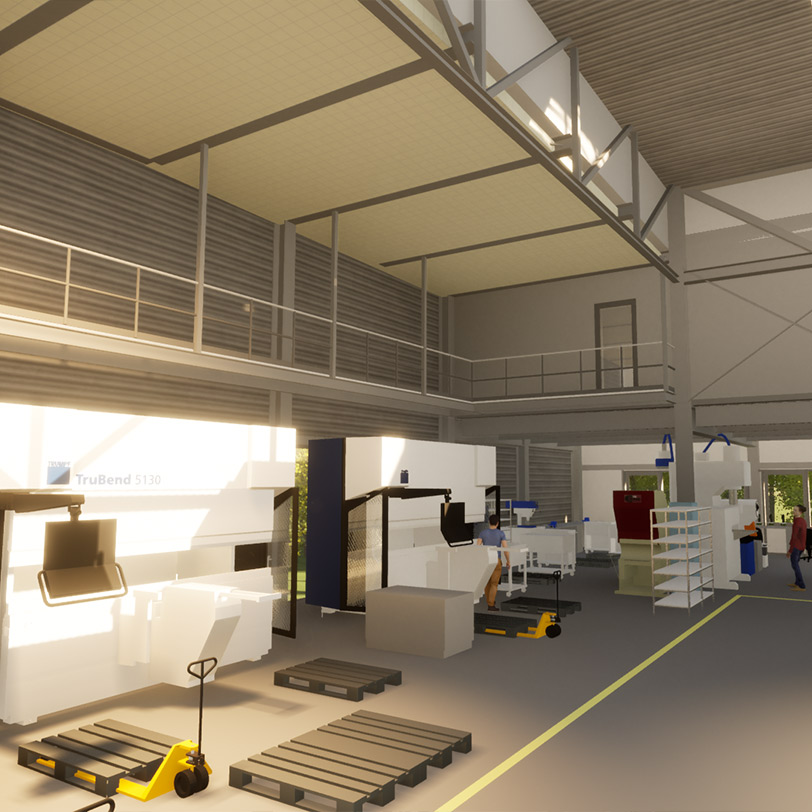
Digital layout planning uses 2D and 3D models to create and optimize virtual representations of production facilities, spaces, or buildings. This innovative approach makes it possible to digitally map production areas and processes as early as the design phase, significantly increasing planning efficiency.
By simulating material flows and processes, potential bottlenecks and inefficiencies can be identified and resolved at an early stage. Technologies such as Virtual Reality (VR) also enable virtual factory tours, providing a realistic visualization of the planned production environment.
Digital layout planning forms the basis for the Digital Twin, which allows real-time analysis and optimization of production. In factory planning, this technology plays a key role in ensuring flexible, future-proof, and seamless production.
A Green Factory and a Smart Factory pursue different objectives, yet both contribute to increasing efficiency and ensuring the long-term viability of production facilities.
Green Factory
-
Focus on sustainability: Reduces CO₂ emissions, energy consumption, and waste.
-
Renewable energy: Relies on solar and wind power as well as resource-efficient technologies.
-
Recycling and circular economy: Ensures closed material cycles and conserves valuable resources.
- Goal: Environmentally friendly and sustainable production that minimizes the ecological footprint.
Smart Factory
- Digital innovation: Utilizes IoT (Internet of Things), Artificial Intelligence (AI), and Big Data.
- Automation and efficiency: Increases production performance and flexibility in real time.
- System integration: Networked machines and equipment enable maximum process optimization.
- Goal: Enhanced efficiency, cost reduction, and flexibility through digital technologies.
Conclusion
While the Green Factory focuses on sustainable production methods, the Smart Factory leverages advanced digital technologies to achieve maximum efficiency and automation. Combining both approaches creates a production environment that is both ecologically sustainable and technologically advanced.
Sustainable factory planning is a key lever for increasing operational efficiency while actively contributing to environmental protection. By combining resource-efficient technologies, climate-friendly concepts, and forward-looking planning, it is possible not only to reduce CO₂ emissions but also to sustainably lower energy and operating costs.
A core element of this approach is the integration of renewable energy sources, for example through the use of photovoltaic systems or solar thermal energy. Intelligent control systems that optimize energy consumption, as well as the adjustment of operating and production schedules, also help minimize the ecological footprint. Additional measures include water-saving systems, material reuse, and holistic waste management strategies that promote recycling and prevent waste generation.
All these measures culminate in a forward-looking factory concept often referred to as a Green Factory – a production facility characterized by particularly eco-friendly and resource-efficient processes. It represents a new generation of industry where sustainability, economic efficiency, and innovation go hand in hand.
The next question, therefore, is how this concept differs from other modern factory models, such as the Smart Factory. Although both approaches are future-oriented, they pursue different priorities.