Industrial companies are continually faced with the challenge of making production more efficient, using resources more effectively and making decisions based on reliable information. Over the past decades, machinery, automation technology and digital systems have made significant contributions in these areas. Artificial intelligence is now bringing another technology into focus.
Few digitalisation topics are currently being discussed as intensively as AI. At the same time, it often remains unclear what AI can actually achieve in an industrial environment. There is a significant difference between visionary ideas of the future, readily accessible AI-powered text assistants and robust applications in production, logistics or factory planning.
For industrial companies, therefore, the key question is not whether they should use as many AI applications as possible. Instead, the question is:
What specific problem needs to be solved, what data is available and which technology is best suited to the particular use case?
From Digitalisation to AI-Enabled Industry
Industrial transformation has never simply reduced the scope of human work. Each new stage of technological development has also created new tasks, skills and requirements. Machinery supported physical activities. Automation stabilised repetitive processes. Digital systems made production and business processes increasingly measurable and transparent. At the same time, the demands placed on planning, control and interdisciplinary collaboration increased.
Artificial intelligence continues this development. It can analyse large volumes of information, identify patterns and restructure information for specific tasks. This distinguishes AI-based methods from many conventionally programmed systems, in which rules and pathways to results are largely predefined.
AI is not a single, uniform tool. The term encompasses a range of different methods:
- Generative AI creates new content based on existing patterns and structures, such as text, summaries, images or program code.
- Large Language Models process language and can summarise, classify or structure information for specific questions or tasks.
- Machine Learning identifies relationships and patterns in data without requiring every individual rule to be explicitly programmed.
- Deep Learning uses multi-layer neural networks and is particularly suited to applications involving image, speech and sensor data.
- Computer Vision analyses images or video data, for example to detect objects or quality deviations.
These methods are not interchangeable. They only create added value when the technology, available data, process and objective are properly aligned.
Why AI Is Becoming Relevant to Industrial Companies
Modern factories generate large and highly diverse volumes of data. Equipment provides operating and condition data. Quality inspections generate measurement data and images. Logistics systems document material movements. Planning projects generate layouts, specifications, reports, calculations and extensive information for decision-making.
However, the availability of data alone does not lead to better decisions. Data may be distributed across different systems, structured inconsistently, outdated or stored without sufficient technical context. Under these circumstances, even a powerful AI model can only provide limited value.
With a reliable data foundation, AI can support decision-makers by:
- analysing large volumes of information more quickly,
- providing relevant content in a more targeted way,
- identifying relationships, patterns and anomalies,
- making knowledge from completed projects more accessible,
- comparing alternatives more systematically, and
- providing a more robust basis for decision-making.
AI does not replace process expertise or engineering experience. A model does not automatically understand the operational consequences of a layout change, an inadequate data foundation or a specific technical constraint. Expert assessment therefore remains an essential part of every industrial AI application.
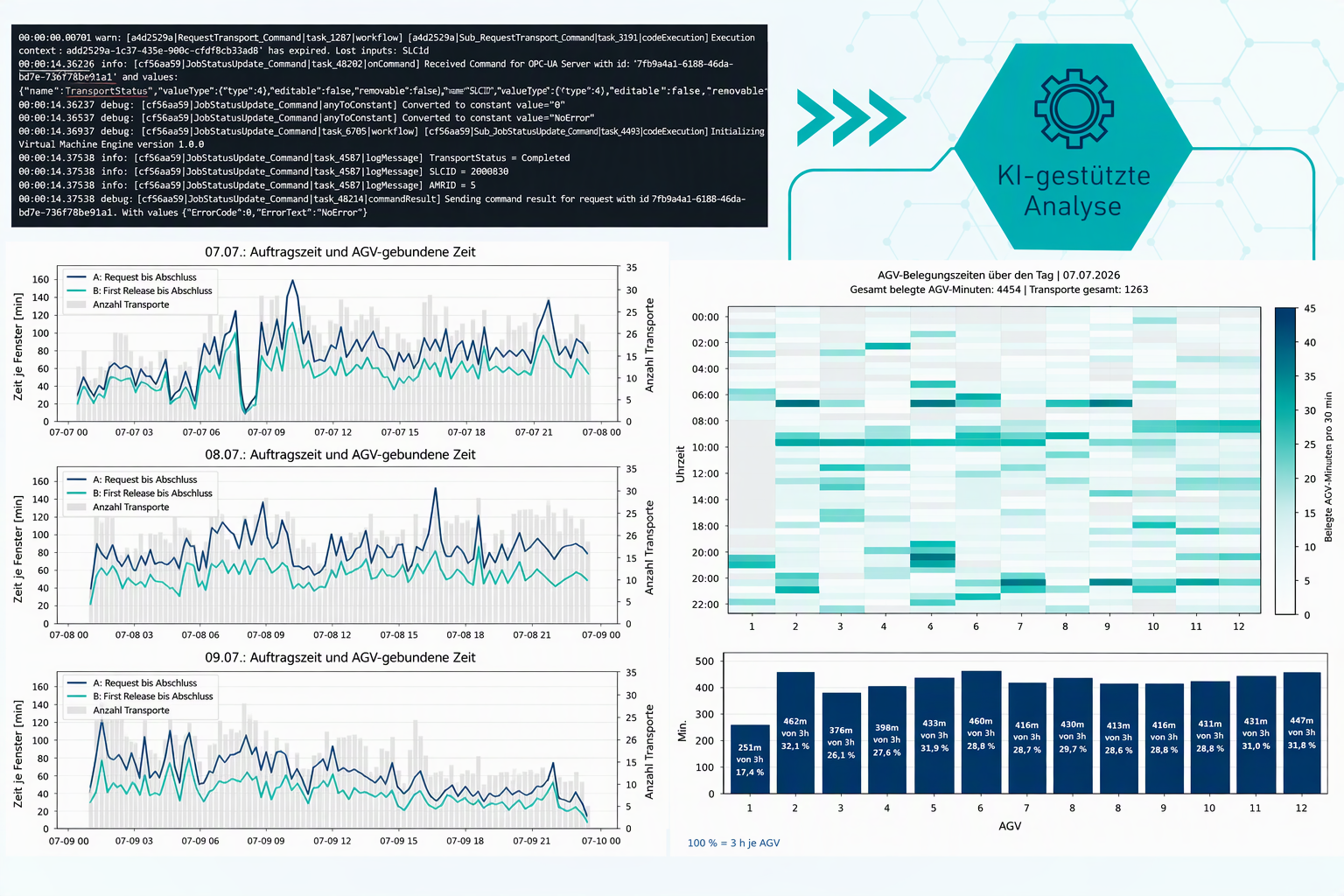
Previous project experience also demonstrates the importance of a structured data foundation for digital planning methods: in one complex project, large volumes of data were processed and analysed, providing the basis for simulating the automation of a production system. In this way, data analysis and simulation can help assess process workflows before implementation and provide a more reliable basis for decision-making.
AI Is No Substitute for Structured Processes
Not every challenge requires an AI solution. Problems often arise from unclear responsibilities, poorly coordinated workflows, fragmented systems or insufficient data quality. In such cases, the process itself must first be improved.
A robust AI use case should therefore answer at least five questions:
- What specific operational problem needs to be solved?
- How will the expected benefits be measured?
- What data is required and what is its quality?
- What incorrect decisions could the system cause?
- Who reviews and takes responsibility for the results?
Only then should a decision be made as to whether AI is actually the right solution or whether conventional data analysis, automation, simulation or process optimisation would be sufficient.
Data quality, traceability and information security are fundamental prerequisites. Particularly when dealing with technical drawings, formulations, supplier data, product portfolios or performance indicators, it must be clear which data a system is permitted to access, how that data is processed and who is responsible for professionally assessing the results. Computational effort and expected benefits should also remain proportionate.
How Companies Can Get Started Effectively
A practical starting point is a clearly defined use case whose results can be professionally verified. Particularly suitable tasks are those where:
- there is a clearly identifiable opportunity to save time or improve quality,
- sufficient structured data is available,
- results can be reviewed by specialists,
- an incorrect output cannot lead to uncontrollable consequences, and
- the benefits and effort involved can be measured.
At MPC, AI applications are also being investigated and tested step by step. Clearly defined use cases are initially compared against existing documents, data or calculation methods and then assessed by subject-matter experts. The key is to achieve reliable results before applications are further standardised or automated.
This approach can also be applied to industrial companies: start small, establish a reliable baseline, measure the results and only then scale up.
Conclusion: The Right Application in the Right Place
Artificial intelligence expands the possibilities of industrial digitalisation. It can structure large volumes of information, make knowledge more accessible, identify patterns and support decision-making. However, its benefits do not arise automatically simply by introducing a new system.
Successful applications start with a clearly defined problem, reliable data and a professionally comprehensible assessment framework. In factory planning and production, AI must also be integrated into the existing interplay between processes, technology, material flow, organisation and economic viability.
MPC therefore does not view AI as an isolated IT topic. What matters is the combination of technology and industrial expertise. Machine, process and project data must not only be analysed more quickly, but also interpreted correctly and translated into actionable decisions.
The central question is therefore not how many AI applications a company uses. What matters is where AI demonstrably improves quality, transparency, speed or confidence in decision-making, and where a simpler solution remains the better choice.