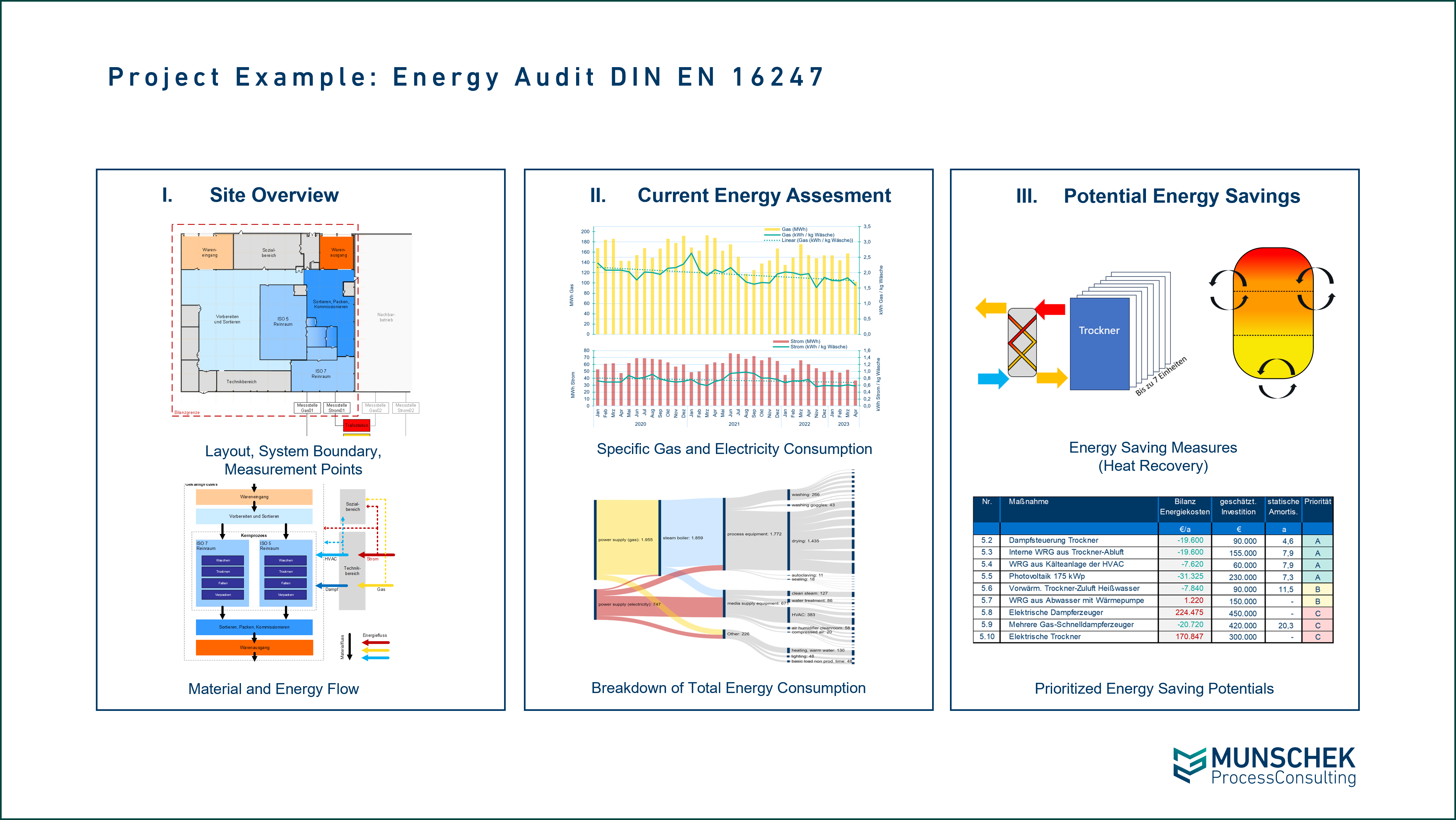
Cleanrooms are among the most energy-intensive production environments. High air change rates, strict temperature and humidity requirements, and complex ventilation and filtration concepts result in a significant share of a company’s total energy consumption being attributable to cleanroom areas. At the same time, companies are facing growing pressure to reduce energy consumption, meet CO2 targets, and comply with increasing regulatory requirements (e.g. CSRD, GHG reporting, energy audit obligations).
Purely technical optimization is no longer sufficient. What is required is a holistic approach that considers production processes, technical systems, building infrastructure, and organizational workflows in equal measure.
We recently presented these topics in a lecture at LOUNGES Cleanroom and Processes in Karlsruhe. For those who were unable to attend in person, we are offering the content online in a webinar on April 23.
Holistic Energy Optimization: From Process to Transformation
Energy efficiency does not start with technology – it starts within the value creation process. Only when process requirements, loads, and personnel and material flows are fully understood can a targeted and effective energy concept be developed.
Key building blocks of a holistic approach include:
- Analysis of value creation: thermal and particulate loads
- Alignment with building services and operational technology
- Integration of renewable energy and optimization of energy transformation
- Evaluation of alternative technology options
- Development of a decarbonization strategy
This results in an approach that understands sustainable energy efficiency not as one-time measure, but as a continuous improvement process.
Framework for Energy-Efficient Cleanroom Planning
VDI 2083-4.2 (2025) provides a structured framework for systematically planning energy efficiency. It considers both direct influencing factors such as Temperature, air change rates, and cleanliness requirements, as well as indirect drivers such as process loads, personnel intensity, and operating hours.
Key planning questions include:
- How can air volume flows and pressure cascades be designed efficiently?
- Which cleanroom zones are truly necessary for the production process?
- How can personnel and material flows be optimally integrated to reduce energy consumption?
Process and Parameter Analysis: The Basis of Every Efficient Concept
A realistic design begins with a detailed analysis of the factors that drive energy demand.
Areas of Analysis include:
- Cleanroom: cleanliness classes, airflow concepts, pressure levels, temperature, and humidity
- Processes: emissions, activities, media requirements, quality requirements
- Personnel: movement patterns, activities, shift systems
- Material: packaging, quantities, delivery frequency
- Building & TGA: climatic conditions, technical constraints
Based on these analyses, companies can define precise requirements and systematically identify the energy efficiency potential within their cleanroom operations.
Cleanroom and Ventilation Concepts: Targeted Management of Energy Demand
An effective energy optimization concept typically encompasses the following elements:
1. Zoning and Layout Design
Demand-driven cleanroom zoning, elimination of over-classified zones, reduction of air volume flows, and minimization of particle-generating activities.
2. Material Flow and Packaging Concepts
Optimized intralogistics, reduced airlock cycles, and lower overall space requirements.
3. Personnel Flow and Garment Concepts
Well-defined airlock structures and gowning sequences with clearly designated personnel flow routes.
4. Ventilation System Design
Selection between centralized and decentralized air supply systems, and project-specific integration of recirculation concepts.
The specific implementation always depends on process requirements, the level of operational flexibility needed, and existing spatial constraints.
Energy-Efficient Measures: From Analysis to Implementation
Energy efficiency in cleanrooms is not a one-off project, but an ongoing process. Companies that combine process analysis, standards-compliant design, intelligent ventilation concepts, and modern building technology can maintain production quality while sustainably reducing energy consumption.
This is particularly relevant in highly regulated industries such as medical technology, pharmaceuticals, or electronics manufacturing, where energy efficiency has become a decisive factor for both economic performance and ecological responsibility.
Funding and Investment support
Investments in energy efficiency can frequently be supported by funding programs. Both large-scale projects and individual measures may qualify.
Which funding options are most applicable, and how efficiency measures can be implemented in a cost-effective manner will be discussed in greater detail during the webinar.
Energy efficiency as a Continuous Improvement Process
Energy efficiency in cleanrooms is not a one-time initiative, but a continuous improvement process that integrates technical, organizational, and strategic elements.
The combination of process analysis, standards-compliant cleanroom design, intelligent ventilation concepts, and modern building technology enables companies to safeguard production quality while sustainably reducing energy and CO2 consumption.
This is particularly relevant in highly regulated industries such as medical technology, pharmaceuticals, and electronics manufacturing, where energy efficiency is increasingly becoming a decisive competitive factor – both economically and ecologically.
Webinar: Access the Content online
For those who were unable to attend our presentation at LOUNGES Cleanroom and Processes in Karlsruhe, we are making the content available again in our webinar on April 23. The central concepts will be explored in a practice-oriented format, and real-world challenges will be examined in depth.
Register now for the webinar!
Energy Efficiency In and Around the Cleanroom