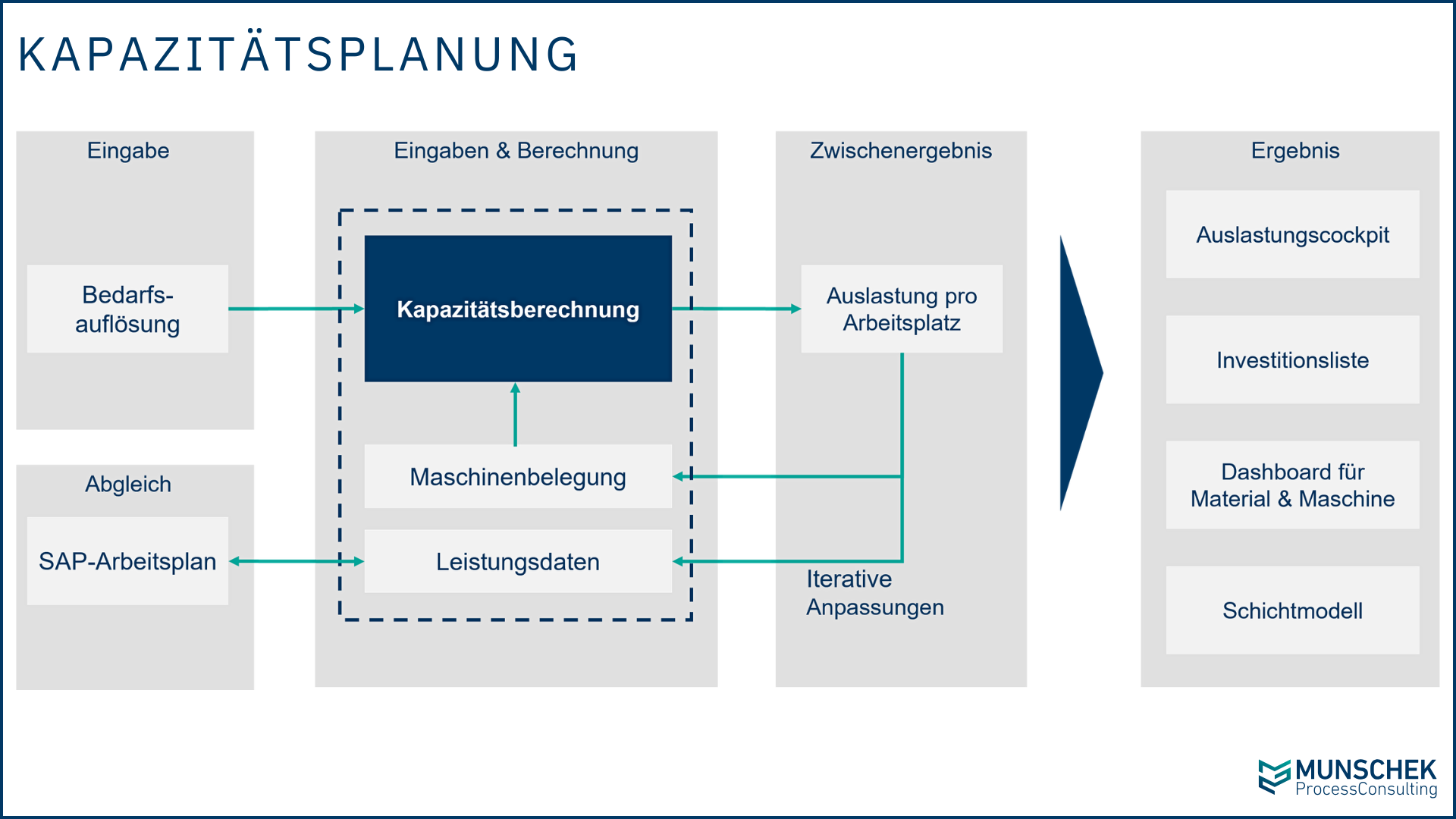
Capacity planning is a core control instrument of modern production organizations. Especially in complex manufacturing environments with large machine fleets, diverse product portfolios and long planning horizons, the demands on methodology, data quality and transparency increase significantly. Companies must ensure that equipment is utilized efficiently, workforce requirements are planned realistically, and investment decisions are prepared on a sound and reliable basis.
Professional capacity planning provides exactly this foundation: it structures large volumes of data, makes interdependencies visible, and translates complexity into clear, actionable recommendations.
Long-Term Capacity Planning Across Machines, Products and Shift Models
In a reference project, the task was to assess the capacity of an extensive machine park over a period of more than ten years. The planning scope included 130 machines, more than 400 machine-product combinations, and four different shift models. In addition, fluctuating demand volumes, varying cycle times, and parallel planning for an existing plant and a new facility had to be taken into account.
This multitude of influencing factors significantly increases planning complexity. Without a structured approach, bottlenecks, overcapacity or investment decisions that later prove inefficient can quickly arise. A consistent and transparent planning process is therefore essential – one that is capable of realistically reflecting future uncertainties.
Application-Oriented Customization of a Capacity Planning Tool
To meet the project requirements, an existing capacity planning tool was customized to meet specific needs and optimized for user-friendliness and data consolidation. The goal was to create a standardized, transparent calculation methodology that would also be easy to use in day-to-day operations.
Key requirements for the tool included:
- Standardized and transparent calculation logic
- Intuitive usability, even for non-technical users
- Efficient processing of large data volumes
- High flexibility in adjusting planning assumptions
The tool enables iterative scenario adjustments and ensures that changes – such as demand forecasts, product allocations or shift models – are consistently reflected throughout the entire planning model at any time. As a result, capacity planning becomes a reproducible and reliable process.
Analysis of Machine Utilization and Shift Models
By systematically consolidating all relevant data, machine utilizations can be analyzed realistically over many years. Different shift models can be compared in a structured manner, and their impact on utilization levels, bottlenecks, and personnel requirements can be evaluated.
The analyses provide, among other insights:
- Identification of critical machines and future bottlenecks
- Evaluation of alternative shift models
- Derivation of required workforce capacity
- Transparent representation of product-specific machine assignments
The results are visualized in clear, intuitive dashboards that make complex relationships easy to understand and support informed decision-making at a glance.
Deriving Investment Timing and Factory Expansion Needs
A key benefit of systematic capacity planning lies in the forward-looking identification of investment needs. Rather than reacting to bottlenecks once they occur, future capacity constraints can be identified at an early stage. This enables companies to deliberately schedule investments, evaluate alternatives, or defer decisions in response to changing market conditions.
In the reference project, this made it possible to:
- Determine optimal investment timing for new equipment
- Asses the need for factory expansions
- Evaluate organizational measures as alternatives to capital investment
This created a robust decision-making basis for strategic long-term planning.
A Clear Decision Framework for Production and Management
The outcome of the project is a comprehensive and resilient target-state picture of production capabilities. It includes long-term machine utilization profiles, concrete recommendations for machine assignments, transparent workforce requirements, and a sound basis for investment decisions.
Thanks to the high flexibility of the developed tool, the company can respond quickly to changing conditions – an essential advantage in dynamic and competitive markets.
Conclusion
Capacity planning is far more than the analysis of large datasets. It is a strategic management instrument that creates transparency, reduces risk, and supports future-oriented decisions. With a clear methodology, a powerful planning tool, and consistent evaluation, it becomes possible to realistically map the performance of complex production systems over many years.
This reference project demonstrates how structured capacity planning can become a decisive success factor for sustainable growth and efficient production structures.